Archive

Posts Tagged ‘Tutorial’

Toulouse tutorial, 6-7 October 2014

October 3rd, 2014 No comments

We are running our second tutorial in Toulouse, hosted by the National Institute for Agricultural Research (INRA) and organised by the Plate-forme bio-informatique GenoToul.

You can download the following files  mixOmics-material,  R scripts to run the command lines and presentation slides  here.

Categories: News Tags:

Toulouse tutorial 6-7 Oct 2014 – Registration

September 17th, 2014 No comments

Training fees

For INRA staff: this training session is not supported by INRA professional training, therefore, you do not have to provide an individual request training. An attendance certificate will be delivered at the end of the training session. For non-INRA staff: INRA has no training agreement. Fees for the 2-day tutorial:

  • for INRA staff: 150€  (no taxes)
  • for academic staff but non-INRA: 150€ + 20% taxes (TVA)
  • for non-academic: 500€ + 20% taxes (TVA)

Registration includes:

  • access to our facilities and to a workstation if requested (we encourage the participants to bring their own laptops to perform their analyses),
  • online course material that will be available on this website,
  • hard copy of the course material and answers to exercises/ case studies will provided during the training session.
  • morning and afternoon coffee breaks and lunch.

All registration has to be confirmed upon receipt of a purchase order addressed to: INRA-MIAT-PF BIOINFORMATIQUE Chemin de Borde Rouge CS 52627 – Auzeville 31326 Castanet Tolosan France or secretariat-miat(at)toulouse.inra.fr

Payment

By cheque: with a copy of your registration confirmation with the training session name. The cheque should be written to ACS INRA and adressed to: INRA-BIA – chemin de borde rouge – Auzeville – CS 52627 – 31326 Castanet Tolosan cedex – France By purchase order:

  • domiciliation: TP Toulouse
  • bank code: 10071
  • counter code: 31000
  • bank account number: 00001002650  – key : 96
  • bank postal address: INRA TOULOUSE AC SECONDAIRE – Chemin de BORDE ROUGE – CS 52627 – 31326 CASTANET TOLOSAN CEDEX
  • IBAN: FR76 1007 1310 0000 0010 0265 096
  • BIC: TRPUFRP1

Registration cancellation policy: If your circumstances change and you are unable to attend the training session, you must contact secretariat-miat(at)toulouse.inra.fr by no later than 8 days prior to the commencement of the training session. Should you cancel less than 8 days prior to the commencement of the trianing session, no refund will be payable.

Other information

N° SIRET INRA Toulouse: 18007003901134 APE code: 731 Z

Categories: News Tags:

Toulouse tutorial 6-7 Oct 2014: Details

September 17th, 2014 No comments

Training aims

The objective of this tutorial is to introduce the fundamental concepts behind projection-based approaches and illustrate their application on some exemplar studies using the R package mixOmics.  In this tutorial, we will focus on the application of these approaches to medium and high throughput biological data (transcriptomics, metabolomics, proteomics data) using PCA, CCA, PLS, PLS-DA and the variants that the mixOmics team and collaborators have developed.

Training program*

  1. Key methodologies in mixOmics and their variants
    1. Principal Component Analysis: PCA, sparse PCA, NIPALS
    2. Canonical Correlation Analysis: CCA, regularized CCA
    3. Partial Least Squares regression: PLS, sparse PLS
    4. Partial Least Squares Discriminant Analysis: PLS-DA, sparse PLS-DA
    5. Recent developments in mixOmics, including multilevel PLS for repeated measurements and introduction to the integration of multiple data sets
  2. Review on the graphical outputs implemented in mixOmics
    1. Sample plots
    2. Correlation circles
    3. Integrating two data sets: relevance networks and clustered image map
  3. Case studies and applications
    1. Example with PCA: Nutrimouse
    2. Example with CCA: Multidrug
    3. Example with PLS: Liver toxicity
    4. Example with PLS-DA: SRBCT study

* The methodologies will be presented throughout the two days training session. Each methodology will be illustrated on a case study (we will alternate theory and application).

Course material will be available in a hard printed copy and online.

Other information

Details for registration are provided here.

The session will take place in the formation room of the INRA center of Toulouse-Auzeville.

Categories: Graphics, News Tags:

ECCB’14 Tutorial Sept 7

September 3rd, 2014 No comments

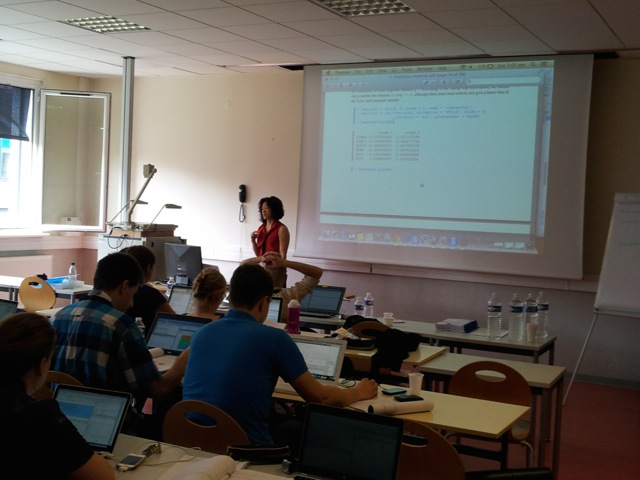
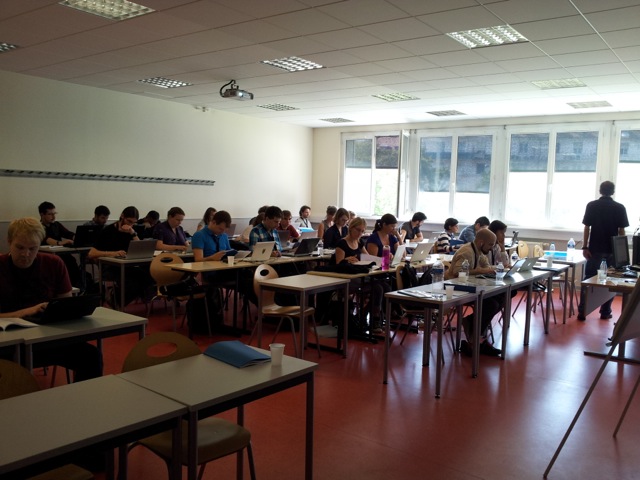
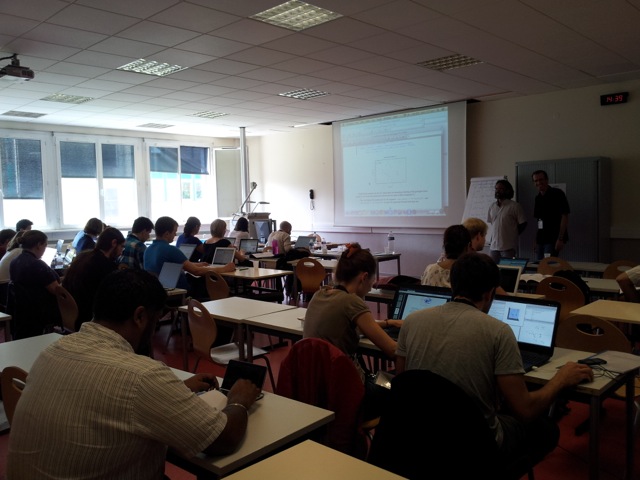
We ran our first mixOmics tutorial as part of the ECCB’14 conference in the beautiful city of Strasbourg. This one-day tutorial was a success and will be followed by other tutorials in 2014 and 2015.

The tutorial material can be downloaded from this link.

Slides : ECCB-mixOmics-slide.pdf     ECCB-mixOmics-CCA-slide.pdf

We will run a two days tutorial in Toulouse, Oct 6-7 2014. Contact us for more information!

20140907_150404 20140907_143715 20140907_14365020140906_193554


Categories: News Tags:

ECCB’14 Tutorial on mixOmics

June 16th, 2014 No comments

ECCB Tutorial T04. Multivariate methodologies for the exploration of large biological data sets. Application in R using the mixOmics package

Date: Sunday Sept 7, 2014
Venue: FORUM building, Faculté de Médecine, 4, rue Kirschleger, Strasbourg
Time: 9am – 5.30pm (registration starts from 8am)
Contact: mixomics[at]math.univ-toulouse.fr
More details: http://www.eccb14.org/program/tutorials/mixomics

 How to register: http://www.eccb14.org/registration Registration includes lunch & coffee breaks on the day of the workshop and the tutorial material (.pdf and/or print). ECCB Tutorial rates: 110 € (academic) or 60 € (student)

Description

The objective of this tutorial is to introduce the fundamental concepts behind projection-based approaches and illustrate their application on some exemplar studies using the R package mixOmics.

Multivariate projection approaches are useful exploratory tools to get a first understanding of large and complex data sets. These approaches are extremely efficient on large data sets, and can also answer complex questions. Such approaches include Principal Component Analysis (PCA, Joliffe 2002) and other variants, Partial Least Squares regression (PLS, Wold 2001), PLS-Discriminant Analysis, Canonical Correlation Analysis (CCA, Hotelling 1936). These approaches enable the reduction of the dimension of the data by projecting them into a smaller subspace. Recent developments proposed the so-called `sparse’ approaches, which include Lasso penalisations to allow variable selection (Tibshirani 2001).

PCA is the oldest and most popular multivariate technique but often, little is known about how this approach is solved and what are the limitations. More sophisticated approaches like PLS and CCA have recently been extended to deal with the large dimension (sparse PLS, or regularized CCA) and were proven to bring biologically meaningful results in many studies. Contrary to PCA, PLS and CCA enable the integration of two types of data sets.

Since 2009, we have implemented many multivariate approaches and their sparse variants in the R package mixOmics to be used by the statistical and bioinformatics community. Full tutorials are given on our website: http://perso.math.univ-toulouse.fr/mixomics/

In this tutorial, we will focus on the application of these approaches to medium and high throughput biological data (transcriptomics, metabolomics, proteomics data) using PCA, CCA, PLS, PLS-DA and the variants that the mixOmics team and collaborators have developed.


Presenters

The presenters are all key developers of mixOmics.

-Dr Kim-Anh Lê Cao (The University of Queensland Dimantina Insitute, Brisbane, Australia). Kim-Anh is a biostatistician researcher in the University of Queensland, Brisbane, Australia. Her institute has a particular focus on severe and chronic diseases such as cancer and diseases involving the immune system, including arthritis, chronic infections, and diabetes. Together with the mixOmics team, Kim-Anh continues to develop methodologies to analyse complex biological studies.

-Dr Sébastien Déjean (Institut de Mathématiques de Toulouse, Université de Toulouse, France). Sebastien is a statistician research engineer in the Universite de Toulouse. Through his support activities to research, he contribues to various projects particularly in the fields of high throughput biology and information retrieval systems.

-Dr Ignacio González (Institut de Mathématiques de Toulouse, Université de Toulouse, Institut National de la Recherche Agronomique, France). Ignacio is working at the plateforme de bioinformatique et biostatistique de Toulouse. Ignacio has been working in several wet laboratories (INSERM, INRA, CNRS, INSA) where he provided statistical support. He has considerable experience in analyzing a vast range of biological data.

Target Audience

Postgraduate students, postdoctoral fellows and researchers with basic statistical knowledge, in need to

-explore large data sets

-use graphical techniques to better visualize data

– apply multivariate projection methodologies to large data sets.

Prerequisite and requirements

We expect the audience to have a good working knowledge in R. Attendees are requested to bring their own laptops, having installed the software RStudio http://www.rstudio.com/ and the R package mixOmics.

Categories: News Tags: